When the mother of Moses laid him into a basket of bulrushes and set him adrift, it was an act of faith eulogized later in scripture, but it was certainly an act of desperation as well. She knew he was an exceptional child, and she had to do something. Many of us felt that way after October 7th. Unspeakable atrocities had happened in Israel, and we were driven to respond. We determined to go to Israel so the people there would know they were not alone. Balaam had prophesied that Israel is “a people who dwells alone, and will not be reckoned with the nations.” But that certainly does not necessitate this kind of suffering and intense isolation and pain, all under the weight of slander and oppressive lies. Israel needed us. They needed our help, our money, our faith—but most of all, they needed us there, bone of their bone, with them in their trials. Perhaps the mark of the days of Messiah is when Israel, in its singular calling, is overwhelmed, not by the hatred of the envious, but with the comfort and goodwill of nations as Israel stands alone before God.
Mike Savage expressed another aspect of the drive that brought us here:
I didn’t want to watch the video of Hamas’ barbarity [shown at the Jerusalem Prayer Breakfast a couple days before the Solidarity Trip], but I knew I had to watch it because I came to be a witness. I had to see firsthand. I want to be a witness not just of the evil of Hamas, but also of the resilience and love of the Israeli people.
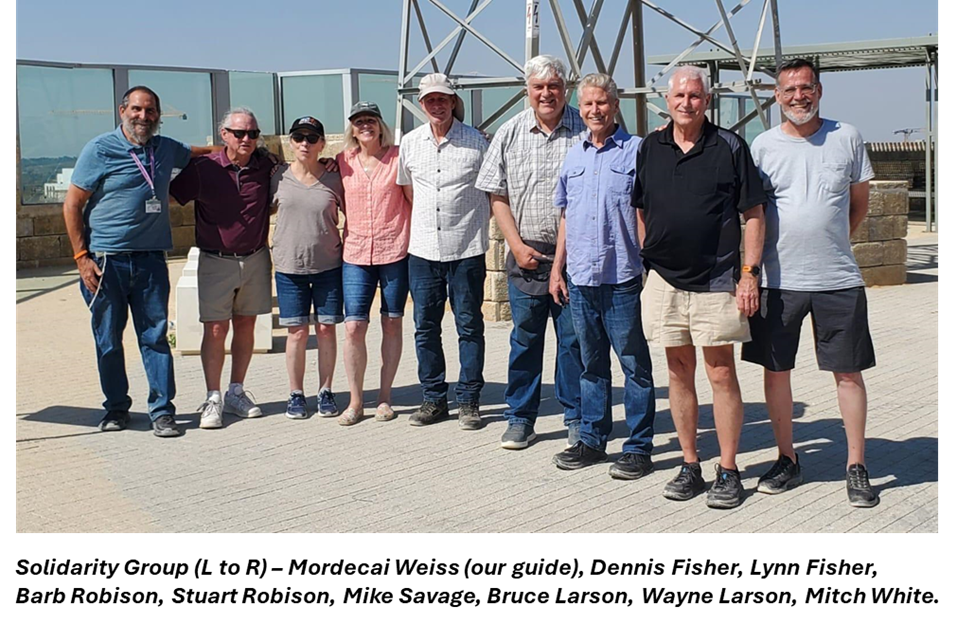
We had been to Israel before and had seen the archaeological sites—this was not that. Rabbi Mordecai, our intrepid guide, had arranged venues of service for us. We would sort fruit, assemble medical kits, make sandwiches, and buy pizza for the IDF soldiers in Hebron. And we would spend money in restaurants, bringing our “wealth of the nations” into Jerusalem (do not despise the day of small beginnings).
Israel is a miracle land of miracle people; treasures hidden in very earthen vessels. The people are knit together by cords of suffering and pride, and by an insatiable passion for life. Now they share the wound of those lost to the massacre of Hamas and those still exiled in its dark land. The pictures of the hostages are everywhere, from the airport to the city streets. Pao, our contact for Eran’s Angels marked the return of the four hostages by stenciling a blue heart on their pictures, among 240 hostage pictures pasted on the entry wall leading inside the parking structure.
Israel’s Appreciation of Those Who Come
It is difficult for those outside Israel to empathize with Israelis in their sense of isolation and betrayal. The raw wounds of the Hamas massacre and kidnappings are compounded by the malignment of Israel in the media, accusations against the IDF from international organizations, and betrayal by former allies. The sense of abandonment by the civilized world goes deep in their bones, and it is personal for them. So the simple expression of love and solidarity from someone who has made the effort to go to Israel is received like a cup of cold water in the desert. When some of us were crossing the street we engaged in conversation with an Orthodox couple—their little boy riding on Papa’s shoulders—and when they learned that we had come to Israel for such a time as this, and that we were volunteering and bringing pizza to IDF soldiers, their hearts opened in astonished gratitude that we would care about them. Beautiful Tamar, a teacher at the Shiloh Children’s Fund, diminutive and exuberant with life and vision, thanked us lavishly that we had come to stand with them. And Ganit, our tour guide to explain the car graveyard of burned out and bullet-ridden cars before us (see below), was stunned to learn that we had come all the way from America—even more, that we as Christians would care about the plight of the communities in Southern Israel.
For Dennis and Lynn Fisher, this was their entire reason for coming to Israel, to comfort God’s people (Isaiah 40:1). “Our purpose was to bring comfort to the people of Israel, to bless God’s people. Wherever we went, especially the servers in the restaurants, everyone was blown away that we had spent the money and took the time to come here to Israel to stand with them.”
Israel’s Startup / Grassroots Charities
Israel is a nation born in fire and blood, steeped in the DNA of Torah, with purpose and mission to serve embedded in their fiber. They are quick to respond to need—not just in their own communities; Israel is often among the first to arrive at disaster scenes around the world. We witnessed this non-profit entrepreneurialism again and again as we visited numerous startup organizations. All it takes is one person that sees the need and has vision.
Underlying this amazing initiative and vision in all these charities is a heart of compassion. Stuart expressed this idea in his own words:
This love and care for one another was common to every charity we visited. None of the charities were started or funded by government agencies. They all began at a grass roots level; someone or some group of people saw a need and set about to meet that need. I went to Israel to be a help, comfort and strength to the Jewish people. But I received more than I gave: A new awareness of the love of God in the Jewish heart and their commitment to love and care for each other.
United Hatzalah
For United Hatzalah, the person with the vision was Eli Beer. As an EMT responding to an emergency of a choking child, he realized all his medical training was useless if he could not get through the Jerusalem traffic and save the child. This motivated him to innovate the approach to emergency medical situations. He developed a network of trained EMT volunteers, currently numbering 7000, dispersed across Israel. The volunteers are comprised of all races and religions, and they are equally inclusive in serving all humanity. By combining the cutting edge communication and GPS technology, and using “ambucycles” (motorcycles equipped with EMT supplies) which can speed between lanes of a traffic jam, United Hatzalah has reduced emergency response times down to 3 minutes, with a goal of no more than 90 seconds.
Our guide at Hatzalah was Yoni, an open-hearted inclusive man, very committed to the vision of Hatzalah. He first told us his own experience on October 7th, and then explained the amazing vision and technological wonder that Hatzalah has become. Stuart again spoke for all of us regarding Yoni and the vision of Hatzalah:
I felt God’s love as he spoke. He also explained the part that their emergency volunteers played on October 7th, the day of the Hamas massacre. Many volunteers went into areas where Hamas was still present, to help the wounded. Two of the volunteers were murdered by Hamas while attempting to save lives. When I heard this, I thought of Christ’s words: “Greater love has no one than this, that someone lay down his life for his friends.”
Leket Food Rescue
Leket Israel is the leading food rescue organization in Israel. It is unique in its approach to serving the poor in Israel because it focuses on retrieving healthy, surplus food and distributing it through partnering non-profits. Leket is a prototypical example of Israeli genetics and ethos—see a need and fulfill it. Leket started when Joseph Gitler began rescuing food from catering halls and cafeterias. He transported them in his Subaru and stored them in refrigerators lining his driveway until he could deliver them to organizations feeding the poor. Since October 7th, as many farmers and field workers have been drafted into the war, Leket has assumed the additional task of providing a work force to harvest the now-unattended fields (Leket means “gleaning” in Hebrew). We were originally slated to do this, to pick produce in the fields, but given our age demographic, we were mercifully reassigned to packing produce inside a Leket warehouse.
Pantry Packers
Pantry Packers is part of Colel Chabad, which is the oldest continually operating network of social services in Israel, founded in 1788. They deliver crates of food and household goods to the poorest of Israel’s population. Normal activities would have involved packing food staples, but because our visit was just a few days before Shavuot (Pentecost) we were given a different assignment. We packed bags filled with water, a pastry, candies, and a prayer sheet which would be handed out to Jews returning from the Kotel (Western Wall) after their traditional all night of Torah reading.
Shiloh Children’s Fund
Shiloh’s Children’s Fund was established to provide therapy through various activities—education, music, sports, agriculture, etc.—to children who have suffered from terrorist attacks. The visionary behind its formation is David Rubin, and the need which he saw came from his own experience. Driving home from Jerusalem in 2001, David’s car came under attack. David was shot in the leg and his three-year-old son Ruby was shot in the head, the bullet passing a millimeter away from what would have been fatal. After his son had physically recovered, David realized that Ruby was still acting out the trauma. This motivated David to create the Shiloh Children’s Fund and find ways to open up the hearts and spirits of children suffering trauma from terrorist attacks to healing.
Since we had toured Shiloh Children’s Fund in previous trips, David focused on showing us the new aspects of the organization. He took us to the horse stable and we met Jehoshua, the horse trainer, and petted two of the gentle horses. Then he took us to a newer building which houses programs for girls. We met the effervescent Tamar, who spoke to us about the agricultural programs she had developed for the girls, including planting trees in honor of fallen soldiers.
Ten O’Clock Breakfast Project
The most unique expression of Israeli innovation in non-profit charities we encountered is the Ten O’Clock Breakfast Project. Poorer Israeli families may not have the means to provide their children with food for the traditional 10 O’Clock breakfast at school. At the memorial for Liel Gidoni, a brave Israeli soldier killed on August of 2014 while fighting in Gaza, it was discovered that when he attended school in Katamon (a poor district of Israel) he would pack two extra sandwiches for the poorer children to have breakfast. In commemoration both of Liel’s kindness and bravery, the Ten O’Clock Breakfast Project was created to provide sandwiches to poor children. It was also noted that there were no photographs of Liel in which he wasn’t smiling, so a picture of Liel with a big smile is placed on every sandwich and then wrapped in plastic.
Eran’s Angels
For the last decade, a small group of friends have come together to distribute food to the needy and Holocaust survivors, visit the wounded in the hospital, and help families during the holidays. When their founder, Eran Hazan, passed away during the Covid epidemic, they adopted his name and became Eran’s Angels. Immediately after October 7th, their numbers jumped from about 80 to 2000 volunteers. They have moved their operation from place to place and finally ended up in the bottom floor of a parking structure at the Tel Aviv Expo and Conference Zone (this also serves as a bomb shelter from Hezbollah or Hamas rockets).
Eran’s Angels is an ad hoc Salvation Army-like operation, with signs roughly penned in Hebrew and English designating each department on the parking lot floor—food, clothing, health aids, kids toys, etc. A sort of Israeli logic, born of necessity, prevails in the way things are organized and orders are fulfilled. Our group was tasked with sorting different linens by both color and pattern. I was pulled away early to another task, but I’m not sure any of us ever really grasped the principles of sorting those linens.
Israel’s Soldiers
Rudyard Kipling wrote a poem “Tommy” to pillory the disrespectful treatment of English soldiers. The soldiers were despised during peacetime, but flattered and elevated in time of war, and always expected to rise up and do their duty on behalf of an unappreciative populace. This poem would make no sense in Israel. Here, everyone serves a minimum of two years in the military and continues in the Reserves for longer. When the government leaders approve military operations, it is their own sons and daughters who will carry out the mission; it is their children who will risk death and injuries. In the small country of Israel, there is only one or two degrees of separation between Israelis. Everyone rejoices in the valor of their soldier’s victories, and everyone mourns the loss of their sons and daughters in battle—each fallen soldier is everyone’s loss.
This high regard for Israel’s defenders is captured in the concept of the Hayil Boded, the lone soldier. This is not just a moniker, but an official designation by the IDF for a soldier who has no family in Israel. The IDF recognizes lone soldiers and the Israeli public also fills the void. Families make room for the lone soldier at Shabbat and Feast meals. Volunteer organizations make it their mission to ensure the lone soldier never feels alone. All of Israel’s defenders are family. In 2014, when Stuart and Evie Steinberg, parents of lone soldier Max Steinberg, fallen in Operation Protective Edge, flew from America to Israel to attend his memorial, Evie thought, “Well, obviously the army will send someone, probably 10 people [a Jewish quorum for prayer] for Max’s memorial service.” To their surprise, 30,000 people attended the service.
Israel National Cemetery
At the Israel National Cemetery we saw the rows of military graves. There is a tradition in Israel to put a rock on the grave of someone to honor them, and we saw that on the graves of soldiers who fought in the earlier wars. But for those fallen in more recent battles, their graves are decorated with photographs, flowers, flags, and all kinds of mementos and crazy memorabilia. It’s a generational thing; but this younger generation of Israeli soldiers is now being baptized in fire and blood.
Before we left the National Cemetery, Mordecai, our guide, led us to a memorial service taking place for a fallen soldier. We heard, in both Hebrew and English, the anguish of the mother and brother for their fallen family member. I thought that the world should see this. Israel reports their losses to the media and the world with perhaps too much objectivity, while casualties on the other side are communicated with rage and a demand for justice. The world needs to feel how Israelis feel, their heart ripped out for fallen soldiers, and for their family members massacred and taken hostage by Hamas.
Pizza Party with Hebron Soldiers
Soldiers in their late teens and early twenties are common in any army, but it’s surreal to see this Tik Tok generation, both boys and girls, as commanders and officers over artillery and tank units. But maturity, patriotism and integrity all coexist with playfulness, youthful optimism and sociability in these young soldiers. It didn’t hurt, of course, that we were bringing them pizza.
It was delightful mingling with this lively group around picnic tables lined with pizzas. In this light-hearted but sincere connection we believe our message came through: “We stand firmly with you and don’t believe the lies. We are grateful for you heroism and self-sacrifice on behalf of Israel and all those who love her.” It was a wonderful afternoon—lots of Hebrew, English, and translating, and many sweet connections confirming our mutual love and appreciation of one another.
Naom, one of the officers, let us try on a soldier’s backpack and shoulder his gun. He also showed us the Operation Room where they run operations against planned terrorists attacks. It was a wonderful time with the soldiers.
Yad LaShiryon (Latrun)
Yad LaShiryon is the Armored Corps Memorial Site and Museum located at Latrun, west of Jerusalem, about halfway to Tel Aviv. The museum contains 110 tanks and other armored vehicles, both Israeli and enemy vehicles. We first viewed the older Israeli tanks, which our guide, Ziv, used to contrast the newer, brilliantly-designed Israeli tank, the Merkava (means “chariot” in Hebrew). This tank, as is true of many Israeli innovations, was born out of necessity. When the British refused to sell the Chieftain tank to the Israelis, a brigade commander, Israel Tal, resumed Israeli plans to build their own tank. He used the knowledge gained in the Yom Kippur war, where so many tanks were lost, to improve Israel’s armored capabilities.
October 7 Nova Memorial and Areas of Battle
By now, everyone has heard about what happened at the Nova Music Festival. What people may not realize is the extent of the Hamas attack, both in geography and in the level of destruction. It was not just the Nova Festival near Re’im, but the Hamas terrorists cut through the barrier all along the 37-mile Gaza/Israel border (see map[1] above). Earlier in our trip, some of us saw the Hamas footage from October 7th. The terrorists were proud of what they did, hunting down and killing terrified children, parents, old people; throwing grenades into bomb shelters packed with people and shooting anyone who emerged; or burning people alive in their cars. To give us an idea of the scope of the attack, Mordecai took us first to the car graveyard near Netivot, then to the Nova Music Festival, and finally to the city of Sderot, where the police station battle took place.
Graveyard of Cars Destroyed by Hamas
The car graveyard outside of Netivot also gives an idea of the scope of the Hamas attack. About three thousand cars, twisted frames, charred, or pierced by bullet holes, lay in neat rows for the distance of a couple football fields. An orange, rusty wall of contorted metal, cars completely burned up, stood as a perimeter around us. Hamas terrorists had used chemical agents to ignite and entirely consume the cars, sometimes with passengers still in them. Ganit, a nearby resident, told us story after story of different cars and how their owners had risked their lives to save people. For example, a doctor, who upon hearing of the massacre, left his home to drive to the scene and help but was burned alive in his car. Ganit (above) owns and runs her farm with her husband and children just a mile or two away. In spite of the horror of these attacks, they are still determined to live successful lives there.
Nova Music Festival
At the Nova Music Festival, we walked through the grounds, trying to reenact in our minds the events of the day—where the stage was set up, where the people were gathered, and the direction from which the hang-gliding terrorists flew in. Most of all, we were trying to process the evil that happened that day. Bruce Larson put into words the depth of emotion we all experienced visiting the Nova Music Festival Memorial Site:
We did not know what we would see or experience when we visited Nova, the site of the massacre on October 7th by Hamas. There were photographs of the young women and men who were slaughtered, placed at each spot where they died. As I slowly walked through the site, it was hard to comprehend the horror of so many innocent young people being massacred. I had not felt such a piercing feeling of Satan’s drive to kill the Jewish people and ultimately all mankind, since I had visited Auschwitz and several of the other Holocaust sites. These young people had come to enjoy an important holiday (Simchat Torah) with music, and to celebrate the joy of the holiday together. The terrorists came upon them suddenly, not just killing human beings, but taking pictures and laughing while they murdered each individual.
Sderot Police Station
As we entered the city of Sderot, we saw a vacant field with twisted rebar sprouting up from the ground, all that was left of the police station in that city. There had been a 24-hour firefight between the Hamas terrorists and the police officers. All the officers inside were killed, and for a time the terrorists took over. Then an Israeli tank rolled through and destroyed the police station, killing all the terrorists inside. Bulldozers levelled the building and cleared away the remaining rubble.
Lunch at ORYOSSS in Sderot
After visiting the police station, we had lunch at an outdoor café with the unique name ORYOSSS. Wayne talked with the owner and relates her story, one that exemplifies the tenacious and indomitable Israeli spirit:
In Sderot, I discovered two hidden gems—one a place, the second a person. “ORYOSSS” is a small gourmet cafe in Sderot, and its owner and proprietor is retired IDF Major Or Schocron. Fittingly, in Hebrew “ORYOSSS” means, “YHVH will cause your life (or light) to increase, or be added to.” The Lord is certainly blessing Major Or’s life—and step by step He is “adding to it.” The awareness of His presence and His blessing of Israel comes through as one samples the entrees and savors the desserts in this restaurant.
As a teenager Major Or was interesting in pastry-making, but instead of pursuing a career in the culinary arts, she joined the IDF, and served her country for thirteen years. During this time, she had two children. In her last seven years of service she took night courses in pastry making, and in 2021 transitioned to army reserve and opened her first restaurant. That year she won national recognition, reaching the finals of “The Perfect Dessert,” a baking competition on TV.
Major Or opened ORYOSSS in August 2023. Only two months later on October 7 Sderot was overrun by Hamas terrorists. Major Or immediately closed the restaurant and volunteered for Israel reserves as Israel prepared for the Gaza offensive. She served in Gaza for four months before returning to Sderot in May 2024, where she reopened her restaurant. Today, you can find this hidden oasis with its scrumptious cuisine right in the shadow of the Sderot destroyed police station site, and a stone’s throw from the Gaza overlook, just 300 meters form the Gaza border.
אין יש לנו ארץ אחרת (We have no other land)
– Golda Meir
The impact and marvel of what we experienced in Israel was synergy—the combination of God’s chosen people living in God’s chosen land. The result defies simple explanations. As Bruce Larson expressed:
I was touched deeply talking with the Jewish people who live near the Nova site by the Gaza border. They suffered through October 7th, and yet continue to raise their families, run their farms, and manage their businesses right next to Gaza. Their response to the horror of what they lived through was to have faith in God, create life in Israel with their families, and bless Israel to be a vibrant flourishing country.
A young lady in a master’s program in Netherlands left the program the day after the massacre and came back to Israel. She first served in Gaza, then volunteered at a nonprofit organization to help others who were struggling in Israel. A group of young men left a successful business in Texas the day after the massacre to come fight in Gaza and defend Israel. Many we spoke with, who lived throughout Israel, including in Samaria and Judea, spoke of Israel being a land given to them by God and they were fiercely determined to defend and bless it.
This drive to create life in the land of Israel reminded me of something that Golda Meir said: “we have no other land”. After the Holocaust, and after the Jewish people had been expelled from numerous countries in which they had lived for centuries, they knew in their gut that Israel was in truth, their only home. Every day they live and fight to protect their home and to create life in the Biblical land of Israel. I felt that God has used all that has happened to the Jewish people to put within their hearts this amazing drive to live in Israel and see it blessed. It has affected my life deeply to see how the Jewish people in Israel are giving their lives while fulfilling God’s word.
[1] https://www.cbsnews.com/news/map-images-israel-gaza-strip-hamas/