AMI Jerusalem Center Newsletter, March – April 2026
The Feast of Passover
by Bruce Larson
The Feast of Passover (Pesach) this year begins at sunset on Wednesday April 1, 2026, which marks the beginning of a new Jewish day. This Biblical feast of Passover (Pesach) has always had a very deep significance for the Jewish people. For Christians the Passover is also very important as it shows God’s faithfulness to His people. Without the deliverance from Egypt there would be no Jewish people, and the events of New Testament would not have happened.
In Exodus 12 we read that each of the families of Israel were instructed to sacrifice an unblemished lamb, put its blood on the two doorposts and lintel of their home, and then eat the lamb roasted in fire with unleavened bread and bitter herbs. He wanted them to eat in this manner, with their loins girded, staff in hand, and in haste so they could leave Egypt quickly. God wanted them to eat unleavened bread not only because He wanted them to be prepared to leave Egypt quickly but also, He wanted them to be free from the leaven (symbolic of sinfulness) of Egypt. As part of the final judgement on Egypt, the first born of both man and beast would die that night except if the Lord saw the blood on the doorposts and lintel He would “Passover” that house. God commanded His people to celebrate this feast throughout their generations and retell how the Lord by His great power fulfilled His promise to Abraham and delivered His people from the “gods of Egypt” (verse 12) so they would be free to serve Him.
The highlight of Passover is the Seder which is observed by Jewish families on the first evening of the feast. There are many important focal points of the Seder, but two of these, the retelling of the story of the Exodus from Egypt and the eating of unleavened bread (Matzah) are commanded in the scriptures. A booklet called the Haggadah guides Jewish families through the Seder and covers very significant points which together not only retell the story of God’s great power that delivered them from Egypt but also powerfully points to God’s redemption in the future from all tyranny. I have been with Jewish families and seen how the parents have told the Exodus story to their children, often in very fun, lively ways that ensure the children will know and remember how God’s great power delivered them. If you are invited by Jewish friends or have a chance in Jerusalem to attend a Passover Seder provided by a Jewish organization or Jewish hotel, I would encourage you to go and experience a Seder.
Exodus 12:15 says that all leaven must be removed from the house prior to Passover and not eaten for 7 days. Even today the observant Jewish people are very careful to remove all leaven from their houses, and I believe this has great significance for us today. During the Seder unleavened bread (Matzah) with bitter herbs is eaten. The bitter herbs are a reminder of the tyranny and sufferings of Egypt mixed with faith that there will be a deliverance from the sufferings of today.
The Seder is arranged around four cups of wine, based on Exodus 6:6-8, which describes the four stages by which the Jews were delivered from bondage. In these verses the Lord says He will “bring you out,” “deliver you from their bondage,” “redeem you,” and “take you to Me for a people.” These four stages of deliverance could also be significant in how the Lord wants to deliver and redeem His people today. There is a fifth expression of deliverance also known as the cup of Elijah which, by tradition, belongs to the time of the Messiah and the ultimate redemption of the Jewish people.
It is interesting to note that the last supper recorded in the Gospels, which took place in Jerusalem with the disciples, was, in fact, a Passover Seder meal. Jesus traveled to Jerusalem with the disciples to observe the Feast of Passover right before His trial, crucifixion, and resurrection. The scriptures require the Jewish people to travel to Jerusalem three times a year for Pesach, Shavuot, and for Succot, and the scriptures show that Jesus, as an observant Jew, did this. From the time long before the birth of Jesus and still to this day the Jewish people generally follow the same pattern of retelling the story of Exodus.
The location of the “upper room” today near the old city of Jerusalem is a 12th century structure built by the Crusaders. The original “upper room” was likely a guest room of a private house which evolved into a 1st century Jewish-Christian synagogue. The foundation of this building dates back to the second temple period.
One important point for Christians today can be found in I Cor. 5:6-8. Paul said that a little leaven leavens the whole lump. He warns us not to be boastful but to get rid of the old leaven within our thoughts and lives. He said to celebrate the feast with the unleavened bread of sincerity and truth. It is important for God’s people to ask the Lord to search their hearts to be free of all influences that don’t align with God’s word. There are many examples of leaven today within the world, but one very important example of leaven is antisemitism. The lies, accusations, and opinions of antisemitism against the Jewish people and Israel are not in alignment with the truth of God’s word.
We just had a large group of Christians from California who visited Israel. They had a wonderful spiritual experience visiting Galilee and other areas such as Qumran where the Dead Sea scrolls were found. The war with Iran started while they were here and in their great love for Israel, they took time to worship, pray for Israel while in Jerusalem, and are now safely home. We are also planning a Solidarity tour to Israel beginning May 17th which I am very excited about. In this tour we will help with Israeli organizations who bless Israel, visit with Israeli soldiers, and show the Israeli people we love and support them.
Please continue to pray for God’s blessing and protection of Israel. Also, I encourage all of us to pray for God’s protection of the Jewish people and for Christians in Iran, in the middle east, and in other countries around the world where they face persecution and physical threats.
“The face of the Lord is against evildoers, To cut off the memory of them from the earth. The righteous cry, and the Lord hears And delivers them out of all their troubles. The Lord is near to the brokenhearted And saves those who are crushed in spirit. Many are the afflictions of the righteous, But the Lord delivers him out of them all. Evil shall slay the wicked, And those who hate the righteous will be condemned. The Lord redeems the soul of His servants, And none of those who take refuge in Him will be condemned.” (Psalm 34:16-19, 21-22)
Reflections from a Visit to the Gaza Envelope
By I. W.
We have been exposed to many stories from those who were at the neighboring towns and communities close to the Gaza area on October 7, 2023. Every one of them has his or her personal memories of what they experienced.
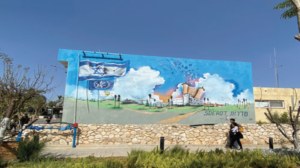
Before this date, I visited kibbutzim and communities in this area, including the Police Station at Sderot. This time, on February 15, 2026, I was asked to join a group and it was a very different visit. The Police Station and its exhibition was no more…
Avi, the guide of the group and a reservist, shared firsthand experiences from the Gaza area. He received a mobilization order and had to go to his special designed area. Avi introduced David, a reservist from Sderot, where he lives with his family. Early morning on Sabbath and Simchat Torah, in spite of the rocket alarms which seemed to be more intense, David went to the synagogue to pray. He brought with him a gun and mobile phone. There were 15 men gathered to pray, another man also had a gun. The intensity of the rockets and shooting came closer to the synagogue, which is a bomb shelter. However, the key of the shelter door could not be found and suddenly terrorists were at the door, firing inside the synagogue. David fired back, it was very critical and it was a miracle that all the men inside the synagogue were saved. The terrorists left the synagogue, David carefully checked the area outside and noticed terrorists were standing outside his home, however, they did not enter, but went on attacking.
About 60 heavily armed terrorists had managed to infiltrate Sderot while a massive barrage of rockets was launched from Gaza, which made it difficult to discover them. The Police Station was one of the main targets, because of what it represented; a governmental authority, which symbolized security for the city and its neighboring communities. An intensive battle followed which lasted for 26 hours, many policemen and security staff were killed, when it was clear there were no more civilians in the police compound, the IDF decided to bomb it, including remaining terrorists – the police station was destroyed.
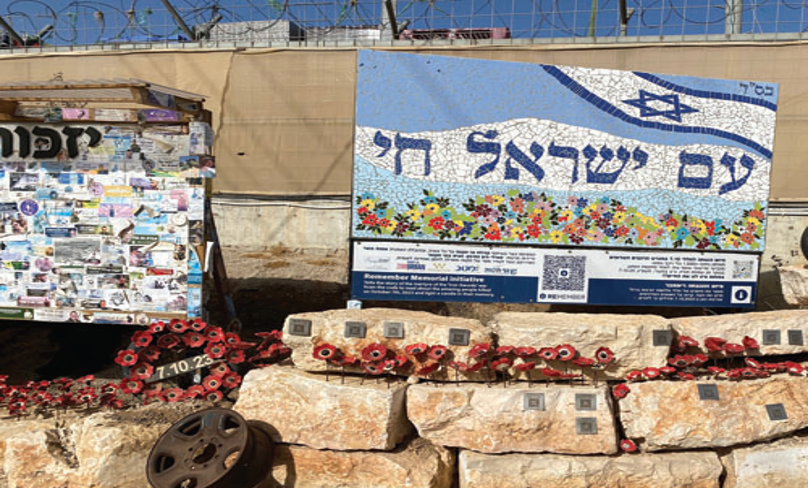
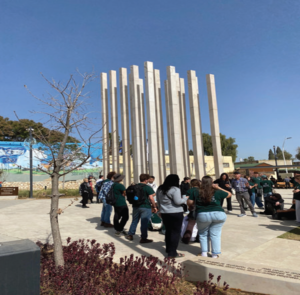
A year after a memorial monument was built on the site of the former Police Station, a monument consisting of 18 pillars (18 is Chai in Hebrew, which means Life): It is named “The Eternal Pillars”. The pillars point upwards to the skies and it forms an empty space in the middle, which symbolizes Standing firm in solidarity with the Sderot community, and the void created when defenders of the residents of the city died protecting it.
There are verses and quotations from the Rabbis and the Talmud on each pillar and on the top, there are letters: “The parchment is burning, but the letters soar upward.” A Torah scroll can be burned, but the letters and spirit remain for eternity. Just like the letters represent the faith, hope, resilience, and the victory of the spirit of the residents of Sderot, the Jewish people have remained through many generations despite numerous challenges and hardships. The inner columns create the phrase: “Am Yisrael Chai.”
Next to the Pillars of Eternity is a wall: “Path of the Fallen” a dedication to the residents of Sderot who were murdered. Stones from the former Police Station were used to build this wall.
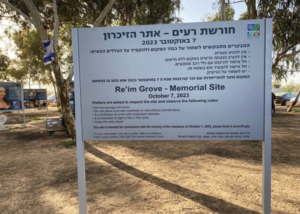
Many groups and individuals are coming to Sderot and its neighboring communities. This day the program also included places like Be’eri, Tekuma, the Car Cemetery, Nova Festival area where KKL (Keren Kayemet L’Israel) and the JNF (Jewish National Fund) is in charge of the memorial site, and a bomb shelter: “the shelter of death” from where people were taken hostage. In spite of all casualties, suffering and victims that day, there were many miracles.
What Do the Jewish Sources Tell Us About a War During Purim?
By Daniel Gwertzman
“There is an appointed time for everything, And there is a time for every event under heaven – A time to give birth and a time to die; A time to plant and a time to uproot what is planted. A time to kill and a time to heal; A time to tear down and a time to build up.” (Ecclesiastes 3:1-3)
This war started during the reading of Zachor, when we are called to remember how Amalek attacked the People of Israel in the desert when they were on their way to the Promised land.
During this Shabbat children were born, after the Sabbath marriages and circumcisions took place in air raid shelters and families prepared for the approaching holiday of Purim despite all the limitations on assembly during the war situation. While Purim is associated with joy and festivity, its real significance is in the way God dealt with the enemies of Israel. This idea is emphasized in Rabbinic literature when we find Yom ha-Kippurim the major fast day on the Jewish Calendar. It is held to be derivative of le-purim (like Purim). If this is the case Purim is holier than Yom Kippur. Therefore Purim and Yom Kippur must have something in common although one is a fast day and the other a feast day. On Purim the fast comes before the feast. On Yom Kippur the feasting comes before the fasting. On Yom Kippur the Jew sanctifies himself and draws close to God by self-denial. On Purim he achieves the same end through joy and pleasure. It is easier to come closer to God by fasting than through the pleasure of the senses.
Maimonides, the Great Medieval Sage, repeats the Midrashic idea that in the days of the Messiah, when all holidays and festivals will be forgotten Purim will still be celebrated. All the prophetic books will lose their relevance, except the Book of Esther. Why will such a thing happen? All holidays have their source in an act of sanctification on the part of a Jew. In the time of Messiah there will be nothing that man can do to add to the general atmosphere of sanctity. Purim, however, came about entirely by Divine Providence. So, when the Jew celebrates Purim in the time of Messiah, He would really learn to appreciate what God had done from his human perspective and really be able to sanctify the festival.
The hidden God of the Megillah whose name is not found there would truly be revealed.
When the Messiah will arrive, there will be no need of admonitions, enforcement or substantiations. The Book of Esther is the story which is a link in the long chain of Jewish efforts to eradicate Amalek which is the symbol of injustice, depravity, and godlessness in the world. The struggle will end when Israel and mankind will be rid of Amalek and what it represents. Therefore, in the days of the Messiah, the Book of Esther will be studied to remind the Jews of the constant warfare they had to endure until the final victory when God’s Holiness will be revealed to the whole world and that He is the true King. So how long will the current struggle last, until Passover, according to some modern commentators. Why should that be the case? That was because the struggle during Passover was really against the Gods of Egypt.
“For I will pass through the land of Egypt on that night, and will strike down all the firstborn in the land of Egypt, both man and beast; and against all the gods of Egypt I will execute judgements – I am the Lord.” (Exodus 12:12)